For All Women and Girls: Rights. Equality. Empowerment.
By Kubet Weston
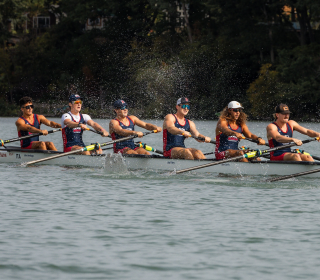
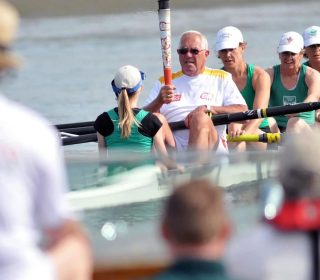
Last year marked the 50th Anniversary of Women’s Rowing at the University of Toronto. The story of the trailblazing women who formed the first women’s program was shared during the boat christening of the ‘Spirit of 1974’. Lynellyn Long (nee Horne) and Joanna Kidd were members of this inaugural crew. Their experiences remind us how the efforts of pioneering individuals can pave the way for future generations and create lasting change.
Lynellyn had rowed previously at Williams College in the US and wanted to continue rowing when she moved to Toronto to attend the University of Toronto. She posted a notice looking for others interested in forming a women’s rowing team. Joanna Kidd was one of the women who responded to the notice and attended the first meeting at Hart House in September 1974. Joanna recalled, “Eight of us stepped up to become the Varsity crew, and another eight – more interested in having fun – became the Junior Varsity eight. Two of the smallest signed up to cox. We knew nothing about rowing but learned the fundamentals on the water, aided by our coaches.”
The women’s team were not sanctioned by U of T and lacked equipment and support. With two volunteer coaches, they trained in the dark fall mornings at the Argonaut Rowing Club. “We had lousy equipment that continually broke. We had no uniforms and virtually no financial support.” At their first race in Hamilton, they battled not only experienced crews from Brock and McMaster but windy conditions that nearly sank their boat. “And despite that, we loved it. We formed a cohesive group and worked hard at getting better.”
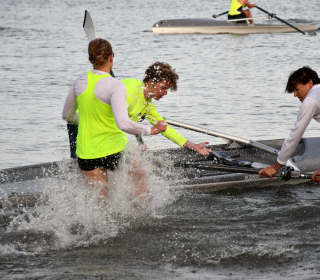
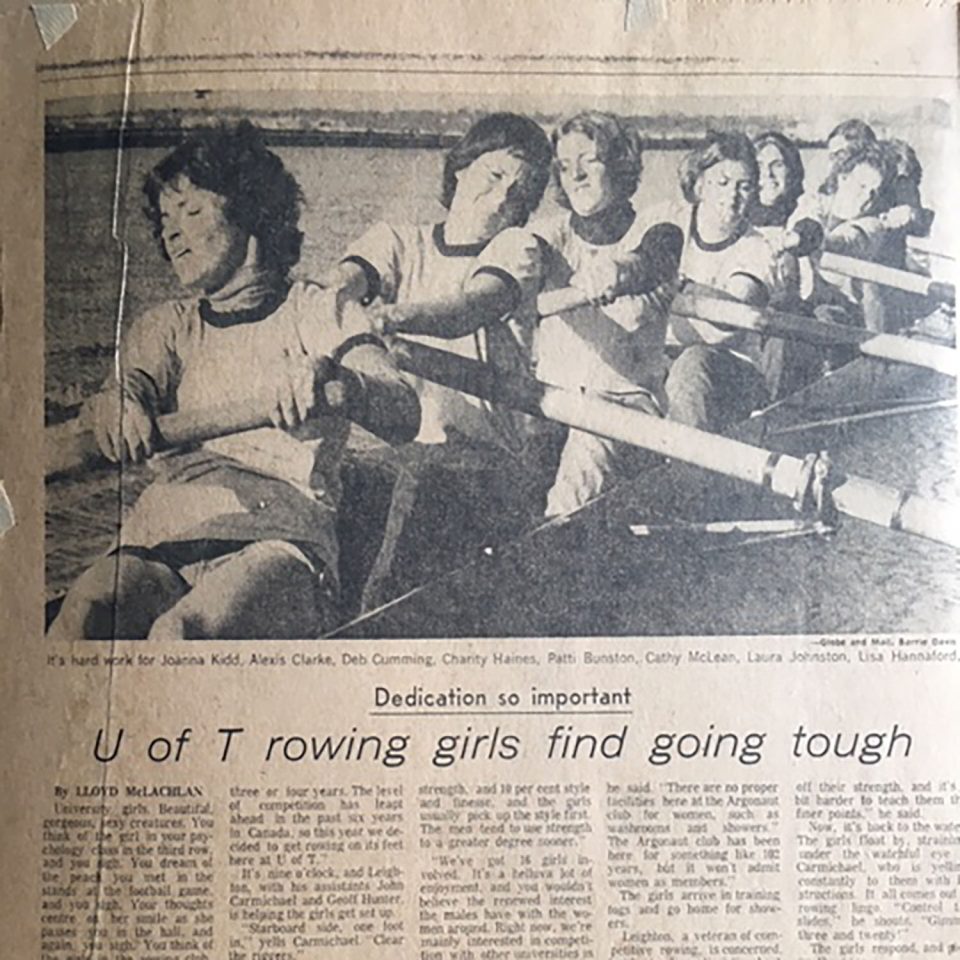
An article published in the Globe and Mail, under the headline “U of T rowing girls find going tough,” alerted the Argo’s board members to their early morning training. Lynellyn said, “Argonauts, like many rowing clubs in Canada, the States and elsewhere, had not decided to go co-ed.” The Board called a meeting and banned the women from using the strictly male-only dock. Not to be deterred, and with the support of the men’s rowing team, the women continued to train for the Ontario University Championships. The men’s crew launched the boat and rowed a distance, and the women waded out from shore to get into the boat and row. Joanna recalls fondly, “And indeed, in our last race- the Ontario University Championships in St. Catharines- we came second last! We had fun. We laughed a lot…we felt brave and free. We could do anything!”
These two women, along with their teammates, took action to promote women’s rights, power, and gender equality in the sport of rowing while at the University of Toronto. At many clubs across Ontario, there are similar stories of the women who led the change, the men who stepped up and supported them, and the lasting change they created for future generations. For Joanna, “The experience taught me a lot about the power of the group – what can be accomplished through hard work and working together. It gave me a lifelong interest in rowing.”
Despite facing challenges like cold water, lack of proper facilities, and limited support, Lynellyn, Joanna and their crew persevered, learning rowing fundamentals and forming a close-knit, dedicated group. Lynellyn’s advice to young female athletes today is to pursue rowing or any sport, even if they don’t make the top team. “I must have taken off about 30 years when I had children and was living in places where I couldn’t row, Vietnam, for example…What got me back was my daughter decided that she was going to row. That’s when I got back.”
Lynellyn continues to row today and shares her wisdom on International Women’s Day: “You just have to decide you’re going to row if you want to row and enjoy it, regardless of whether you’re in the first boat. It’s more important that you just do it and that you really enjoy the people…you build up that camaraderie.” Joanna adds this advice for young female athletes today: “Don’t let anybody tell you that you can’t do something. The greatest benefit of sport is what you learn about yourself as you overcome adversity. Those are the lessons you can apply to your life outside of sport. Have fun.”